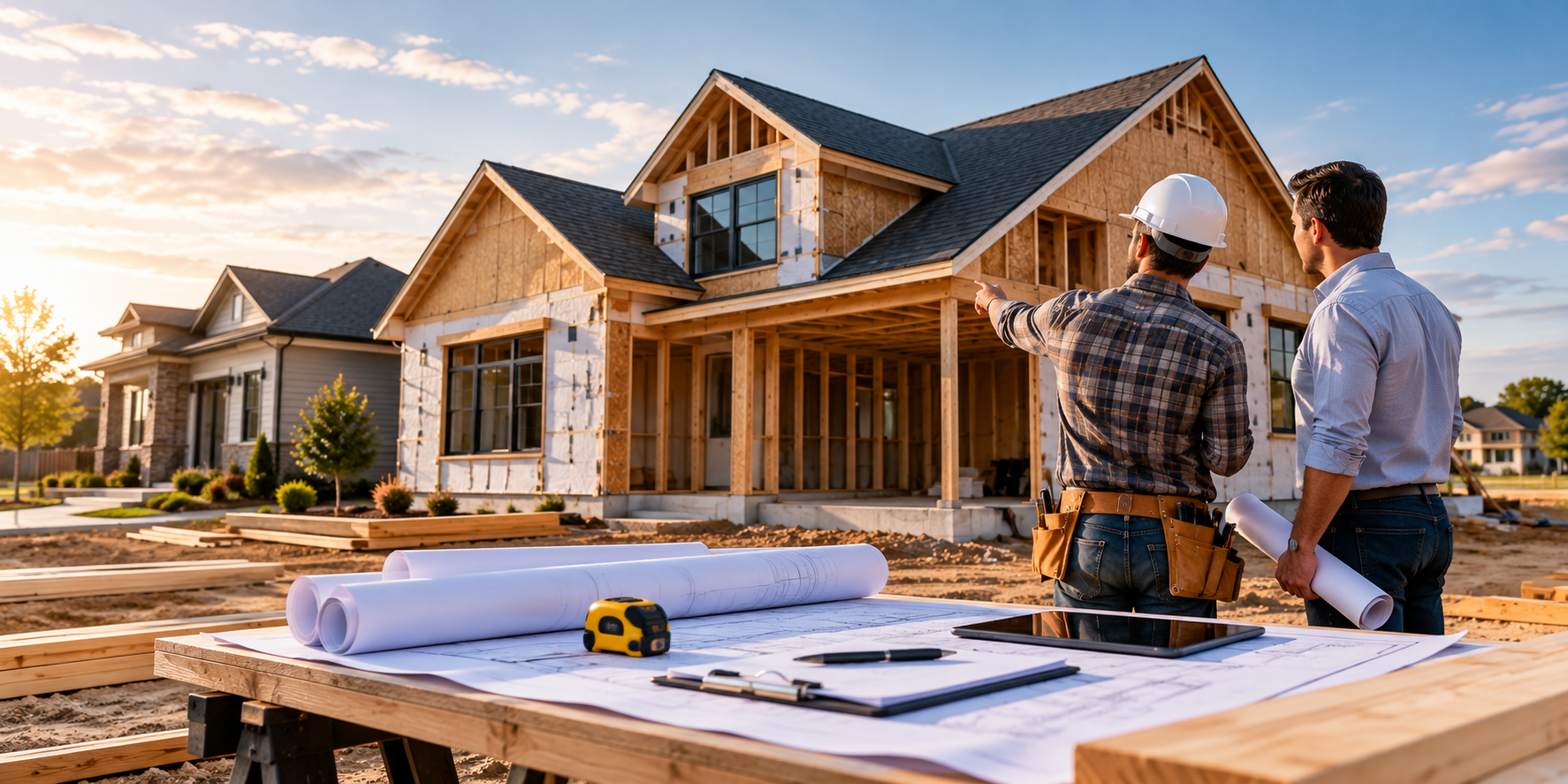
A new-construction home can come with something many resale properties cannot easily match: a financing package designed to make the monthly payment considerably more affordable.
In 2026, that advantage has become especially important.
Mortgage rates remain elevated, buyer traffic has weakened, and builders in many markets are carrying completed or nearly completed homes they want to sell. The result is a growing menu of incentives: below-market mortgage rates, temporary rate buydowns, closing-cost assistance, direct price reductions, upgrade credits and other promotions.
The numbers show how widespread the strategy has become. The National Association of Home Builders reported in September 2026 that 66% of builders were using sales incentives, the highest share since December 2025. Thirty-eight percent had cut prices, with the average reduction holding at 6%.
A separate Realtor.com analysis of new-construction listings found that 18.8% explicitly advertised a buyer incentive in August. Reduced mortgage rates were the most common advertised promotion, appearing on 13.8% of new-construction listings with an average promotional rate of 3.92%.
| New-Construction Market Snapshot | Figure | Source |
|---|---|---|
| Builders using sales incentives (September 2026) | 66% | NAHB |
| Builders cutting prices | 38% | NAHB |
| Average price reduction | 6% | NAHB |
| NAHB/Wells Fargo Housing Market Index (September) | 32 | NAHB |
| New-construction listings advertising a buyer incentive (August) | 18.8% | Realtor.com |
| Listings advertising a reduced mortgage rate | 13.8% | Realtor.com |
| Average promotional rate | 3.92% | Realtor.com |
| New single-family homes for sale (July) | 488,000 (9.6 months of supply) | Census/HUD via NAHB |
For buyers, that creates opportunity—but also a comparison problem.
A $15,000 closing-cost credit, a 4% promotional mortgage rate and a $25,000 price reduction are not interchangeable. The best choice depends on the loan, how long you expect to own the home, how much cash you have at closing and whether the advertised mortgage rate is temporary or permanent.
Before accepting the builder’s headline offer, calculate what it is actually worth to you.
Why Builder Incentives Matter More in 2026
New-home builders face a different business reality from individual home sellers.
A homeowner can decide not to sell. A builder with multiple completed homes has capital tied up in land, construction, financing and inventory. Unsold homes continue to carry costs.
That helps explain why builders may become aggressive when buyer demand slows.
In September, the NAHB/Wells Fargo Housing Market Index fell to 32, its lowest reading since September 2025. NAHB attributed the weakness partly to higher mortgage rates and affordability pressure.
New-home inventory has also remained elevated. In July, there were 488,000 new single-family homes for sale nationally, representing 9.6 months of supply at the prevailing sales pace, according to Census/HUD data summarized by NAHB.
For a buyer, the practical takeaway is simple: do not assume the advertised price is the only financial lever available.
The Main Types of New-Construction Incentives
Builders can structure incentives in several ways. Understanding the difference is essential before comparing communities or offers.
Mortgage Rate Buydowns
A rate buydown uses money upfront to reduce the buyer’s mortgage cost.
A permanent buydown typically involves paying discount points so the mortgage carries a lower interest rate for the life of the loan.
A temporary buydown reduces the effective payment for an initial period before the borrower begins paying based on the full note rate.
For example, a 2-1 temporary buydown generally reduces the effective rate by two percentage points during the first year and one percentage point during the second year before the payment reaches the full note-rate level in year three.
| 2-1 Temporary Buydown | Effective Rate |
|---|---|
| Year one | Two percentage points below the note rate |
| Year two | One percentage point below the note rate |
| Year three onward | Full note rate |
The exact structure should be documented by the lender. Buyers should never infer the terms from a sales sign or online advertisement.
Closing-Cost Credits
A builder may contribute toward eligible closing costs or prepaid expenses.
This can be particularly valuable for a buyer who has enough income to afford the monthly payment but wants to preserve cash for moving, furniture, emergency reserves or other post-closing expenses.
The amount a builder can contribute depends on the loan program, down payment and transaction structure. Financing-concession limits apply, so the builder cannot necessarily give an unlimited credit.
Direct Price Cuts
A lower purchase price reduces the amount you pay for the property and, depending on your financing, can also reduce the mortgage balance, down payment and some transaction costs.
The benefit is straightforward and does not expire after one or two years.
However, a price cut may have a smaller effect on the monthly payment than buyers expect, particularly when mortgage rates are high.
Design, Upgrade and Lot-Premium Credits
Builders may also offer money toward flooring, countertops, appliances, cabinets, landscaping, smart-home features or lot premiums.
These incentives can be useful when you were already planning to buy the upgrades.
But a $20,000 design-center allowance is not automatically worth $20,000 to you. If the included upgrades are priced above comparable market costs—or are features you would not otherwise purchase—the real value may be lower.
| Incentive Type | How It Works | Keep in Mind |
|---|---|---|
| Mortgage rate buydown | Money upfront reduces the buyer’s mortgage cost, permanently or temporarily | Confirm whether the lower rate is temporary or permanent |
| Closing-cost credit | Builder contributes toward eligible closing costs or prepaid expenses | Financing-concession limits apply |
| Direct price cut | Lower purchase price | May have a smaller effect on the monthly payment than buyers expect |
| Design, upgrade and lot-premium credits | Money toward finishes, features or lot premiums | Not automatically worth the full credit amount to you |
A Low Promotional Mortgage Rate Is Not Always the Cheapest Deal
The most eye-catching builder promotion is usually the interest rate.
A sign advertising “3.99% financing” can be compelling when typical market rates are much higher. But buyers need to understand exactly what the number represents.
Ask whether the advertised rate is fixed for the entire loan term or is a temporary buydown; how many discount points are being paid; whether the offer requires the builder’s affiliated lender; whether a specific down payment or credit score is required; which homes and closing dates qualify; what the APR is; and what lender fees apply.
A low interest rate can produce substantial savings, but comparing the rate alone is insufficient.
The Consumer Financial Protection Bureau recommends comparing Loan Estimates from multiple lenders and advises consumers to obtain at least three loan offers when shopping for a mortgage.
That remains useful even when the builder offers a preferred-lender incentive.
Temporary vs. Permanent Rate Buydowns
This distinction can materially change the value of the offer.
With a permanent buydown, discount points are paid upfront to obtain a lower rate that generally applies throughout the mortgage term.
With a temporary buydown, funds subsidize a portion of the early payments, but the borrower’s required payment eventually rises to the amount based on the full note rate.
For eligible VA loans, the Department of Veterans Affairs states that lenders must qualify borrowers using the full monthly payment that will apply after a temporary buydown ends.
That is a useful principle for any buyer: judge affordability based on the eventual payment, not just the first-year promotional amount.
A temporary buydown may make sense if you value lower payments during the first few years. A permanent buydown may be more valuable if you expect to keep the mortgage for a long time.
Neither is automatically superior.
Why Builders Often Prefer Incentives to Large Price Cuts
If a builder can afford a mortgage subsidy, why not simply reduce the home price by the same amount?
One reason is that financing incentives can create a larger immediate monthly-payment benefit than an equivalent price reduction.
Another is that builders may want to protect recorded sale prices within a community.
A significant price cut on one home can affect buyer expectations for the builder’s remaining inventory and potentially influence comparable sales used in future appraisals.
Realtor.com reported in September that major builders have been spending heavily on incentives. Financing incentives can sometimes make the payment substantially more attractive without requiring an equally dramatic reduction in the recorded sale price.
For buyers, however, the builder’s preferred structure is not necessarily your best structure.
Ask whether the incentive can be reallocated.
Could a $20,000 incentive be used for closing costs instead of upgrades? Could some of it fund a permanent rate buydown? Is there an alternative price reduction?
The answer varies by builder, community, lender and loan program, but the question is worth asking.
Should You Use the Builder’s Preferred Lender?
You do not have to use a builder-affiliated mortgage lender simply because the builder recommends one.
The Consumer Financial Protection Bureau advises buyers considering new construction that builders often have associated mortgage lenders but that consumers have the right to shop for a better deal.
Request a Loan Estimate from the preferred lender and comparable offers from outside lenders.
Compare the interest rate, APR, discount points, origination charges, lender credits, builder credits, mortgage insurance, cash to close, monthly principal and interest, whether the rate is temporary or permanent, and the five-year cost of borrowing.
An outside lender with a higher headline rate can occasionally be cheaper once fees are included. Conversely, a heavily subsidized builder-affiliated loan may genuinely be the strongest offer.
Do the calculation rather than assuming either outcome.
How to Compare Two Builder Offers
Imagine a $450,000 new home with two incentive choices.
Offer A provides a $20,000 price reduction.
Offer B keeps the original price but provides financing assistance that lowers the mortgage rate.
| $450,000 New Home | Incentive |
|---|---|
| Offer A | $20,000 price reduction |
| Offer B | Original price, with financing assistance that lowers the mortgage rate |
Which is better?
You cannot answer from the incentive amount alone.
Ask the lender to produce written scenarios showing the loan amount, note rate, APR, points, cash to close, monthly payment and total cost.
Then consider how long you expect to own the property and keep that mortgage.
If you expect to refinance relatively soon, paying heavily for a permanent rate reduction may deliver less long-term value than expected.
If you plan to stay for many years and keep the mortgage, a permanent lower rate may become more valuable.
If cash is the main constraint, closing-cost assistance may solve a more immediate problem than either option.
What Buyers Should Negotiate on a Quick-Move-In Home
Completed and quick-move-in homes can deserve special attention.
Once construction is finished, the builder has already committed the capital and selected the finishes. Carrying the unsold property costs money.
When a home has been completed for some time, ask about additional closing-cost assistance, a permanent or temporary rate buydown, a price reduction, appliance packages, window coverings, landscaping, HOA-fee assistance where permitted, design or upgrade credits, warranty enhancements and lot-premium reductions.
Do not assume every item can be included or financed under your loan program. Have the lender verify the structure before relying on it.
Questions to Ask Before Signing
Before choosing a builder incentive, get clear answers to these questions:
- Is the advertised mortgage rate temporary or permanent?
- What is the full note rate?
- What is the APR?
- How many discount points are being paid?
- Who is funding the buydown?
- Must I use the builder’s preferred lender?
- What happens to the incentive if I use another lender?
- Can I choose a price reduction instead?
- Can the incentive be divided between financing and closing costs?
- Which homes qualify?
- Is there a required closing deadline?
- What credit score or down payment is assumed in the advertisement?
- Are there restrictions under my FHA, VA or conventional loan?
- What will my payment be after a temporary buydown ends?
- How much cash will I actually need at closing?
Get the important terms in writing.
Regional Differences Buyers Should Expect
Builder incentives are not evenly distributed across the country.
Realtor.com’s August 2026 analysis found the greatest prevalence of advertised new-construction incentives in parts of the West and South, while incentives were less common in the Northeast.
That aligns with broader differences in new-home supply.
Buyers in markets with substantial new construction and slower absorption may have more negotiating leverage than buyers in supply-constrained areas.
Even within the same metro, one community may have aggressive incentives while another development from the same builder has little reason to discount.
Compare communities, not just builders.
Red Flags to Watch For
A builder incentive should improve the economics of the purchase, not distract from them.
Investigate further if the advertised rate is presented without clearly stating whether it is temporary; you cannot obtain written loan terms before committing; the builder discourages you from comparing lenders; the incentive requires an unusually fast closing; a large upgrade credit pushes you to buy features you do not value; the sales price appears materially higher than comparable nearby homes; you are budgeting around the first-year payment of a temporary buydown; or you have not reviewed property taxes, insurance and HOA costs.
A financing promotion can make a good home more affordable. It cannot make the wrong property a good purchase.
The Bottom Line
New-construction buyers have an unusual opportunity in 2026.
With 66% of builders reporting the use of sales incentives in September and more than one-third cutting prices, many buyers have room to evaluate more than the sticker price.
But the best incentive is not necessarily the one with the largest advertised number.
A below-market mortgage rate may generate meaningful monthly savings. A closing-cost credit may preserve valuable cash. A direct price reduction may provide more durable value. An upgrade package may make sense if it covers improvements you genuinely planned to buy.
The correct choice depends on your financing, cash position and expected time in the home.
Before signing, ask the builder for every available incentive option. Obtain the preferred lender’s complete Loan Estimate. Get competing mortgage offers. Compare APR, fees, cash to close and the payment after any temporary subsidy ends.
Then negotiate the package—not just the price.
In a market where builders are actively competing for buyers, understanding how incentives work can be worth thousands of dollars.
Related Reading
- Builder Incentives in 2026: Are Mortgage Rate Buydowns and Closing-Cost Credits Worth It?
- Mortgage Rate Locks in 2026: When Should Homebuyers Lock Their Interest Rate?
- Home Price Cuts Are Surging in 2026: What Buyers Should Negotiate Beyond the Asking Price
- Buying an Older Home in 2026: Check These Insurance, Roof and Inspection Issues Before You Close
- Assumable Mortgages in 2026: Can You Take Over a Seller’s Lower Mortgage Rate?
Sources
- National Association of Home Builders — Builder Sentiment Falls on Higher Interest Rates and Costs, September 16, 2026
- Realtor.com Economic Research — Builder Incentives, Especially Reduced Rates, are a Bright Spot for Home Buyers, September 15, 2026
- Consumer Financial Protection Bureau — Find the Right Home
- Consumer Financial Protection Bureau — Shopping for a Mortgage
- Consumer Financial Protection Bureau — Loan Estimate Explainer
- Fannie Mae Selling Guide — Interested Party Contributions
- U.S. Department of Veterans Affairs — Temporary Buydowns
Editorial note: Figures and market conditions were checked against sources available in October 2026. Builder promotions vary by market, community, home, lender, borrower qualifications and loan program. Readers should obtain written terms and compare Loan Estimates before making a financing decision.