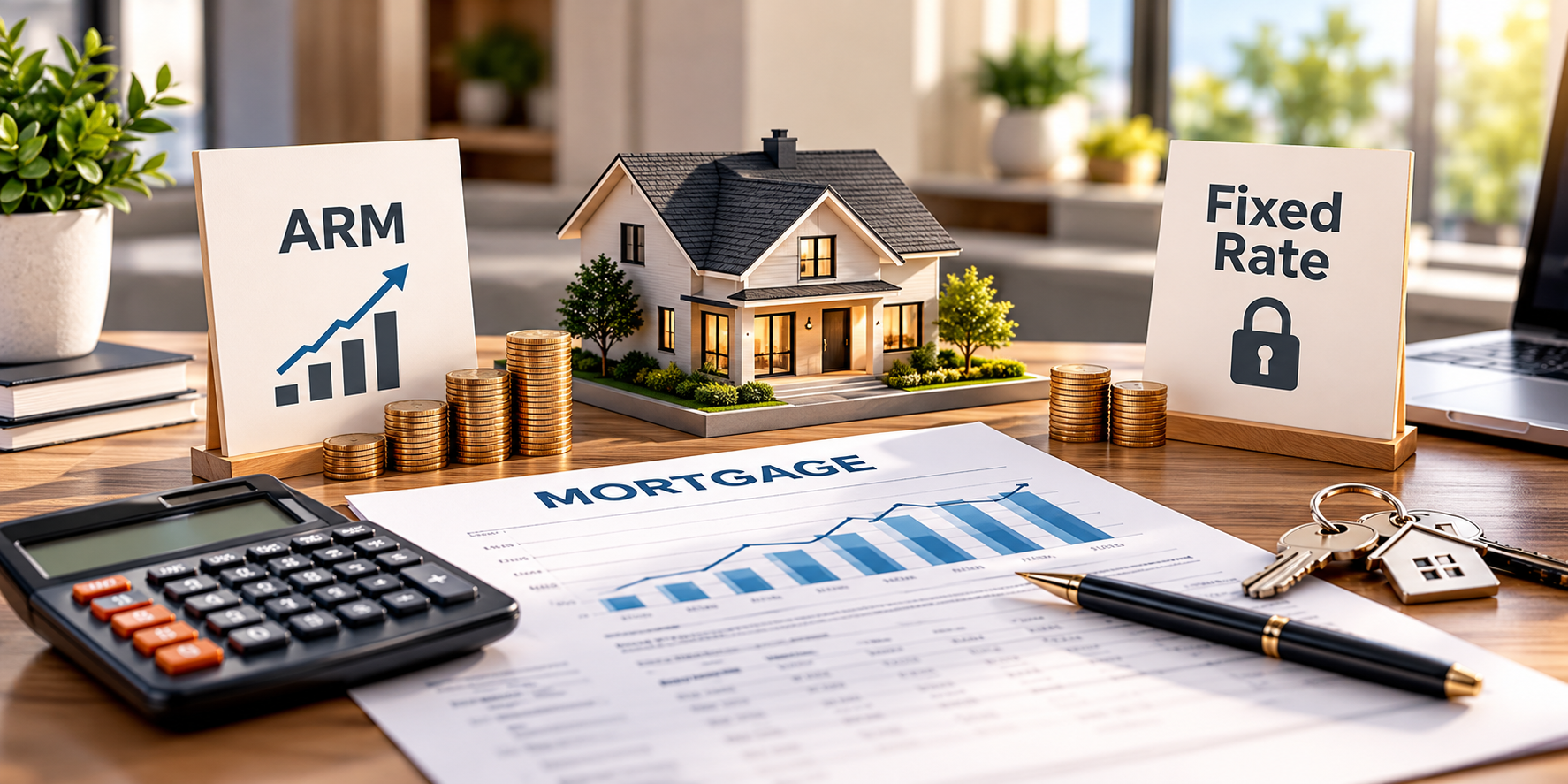
Adjustable-rate mortgages are getting attention again in 2026, and there is a straightforward reason: fixed mortgage rates are expensive.
Freddie Mac reported that the average 30-year fixed mortgage rate reached 7.28% on October 1, 2026. Meanwhile, the Mortgage Bankers Association reported that adjustable-rate mortgages, commonly called ARMs, accounted for 10.3% of mortgage applications in its September 30 weekly survey — the highest share since October 2025. MBA also noted that ARM rates were running roughly 80 basis points below fixed-rate loans at that time.
| 2026 Mortgage Snapshot | Figure | Source |
|---|---|---|
| Average 30-year fixed rate (October 1, 2026) | 7.28% | Freddie Mac |
| 30-year fixed rate in MBA weekly survey (September 30) | About 7.3% | MBA |
| ARM share of mortgage applications | 10.3% (highest since October 2025) | MBA |
| ARM rates vs. fixed rates | Roughly 80 basis points lower | MBA |
For buyers trying to make a monthly payment work, that gap can be meaningful.
But a lower starting rate is only part of the story.
An adjustable-rate mortgage can become more expensive after its initial fixed period ends. The future rate is tied to an index plus a lender-set margin and is limited by adjustment caps written into the loan. If market rates remain high or rise, the payment can increase substantially.
That means an ARM is not simply a cheaper mortgage. It is a different risk structure.
Here is how to evaluate whether an adjustable-rate mortgage makes sense for your 2026 home purchase.
What Is an Adjustable-Rate Mortgage?
An adjustable-rate mortgage is a home loan whose interest rate can change over time.
Most modern ARMs begin with an introductory period during which the rate stays fixed. After that period ends, the rate adjusts according to the terms of the loan.
The Consumer Financial Protection Bureau explains that the new rate is typically calculated using two components:
- Index: A market-based interest-rate benchmark that can move over time.
- Margin: A percentage set by the lender and added to the index.
The index changes with market conditions. The margin generally stays fixed for the life of the loan.
For example, if the applicable index at an adjustment date is 4.25% and the lender margin is 2.75%, the fully indexed rate would be 7.00%, subject to the loan’s rate caps.
| How an ARM Rate Is Calculated | Example |
|---|---|
| Index at the adjustment date | 4.25% |
| + Lender margin | 2.75% |
| = Fully indexed rate | 7.00% (subject to the loan’s rate caps) |
This is why ARM borrowers need to understand more than the introductory rate.
What Does 5/1 ARM Mean?
ARM names describe how long the initial rate remains fixed and how frequently it can adjust afterward.
A traditional 5/1 ARM means:
- The rate remains fixed for the first five years.
- After five years, the rate can adjust once per year.
Other common structures may include 3-year, 7-year and 10-year initial fixed periods. Some newer loans adjust every six months after the fixed period and may be described as 5/6m, 7/6m or 10/6m ARMs.
The CFPB advises buyers to read the loan documents carefully because the adjustment schedule is not identical across every ARM product.
Why Are ARMs Becoming More Popular in 2026?
The renewed interest largely reflects the difference between ARM and fixed mortgage rates.
MBA reported on September 30, 2026 that the 30-year fixed mortgage rate in its weekly survey had climbed to about 7.3%, its highest level in nearly three years. At the same time, ARM rates were approximately 80 basis points lower than fixed rates.
On a large mortgage, a difference of 0.80 percentage points can materially affect the starting payment.
That is particularly attractive for buyers who are already dealing with high home prices, property taxes, homeowners insurance, HOA fees and other ownership costs.
However, the lower payment is not guaranteed to last.
ARM vs. Fixed-Rate Mortgage: The Core Difference
The biggest advantage of a fixed-rate mortgage is predictability.
Once the loan closes, the principal-and-interest rate remains fixed for the term of the mortgage. Property taxes, insurance or HOA expenses may still change, but the mortgage rate itself does not.
An ARM trades some of that certainty for a potentially lower initial rate.
Fixed-Rate Mortgage Advantages
- Predictable principal-and-interest payment
- Protection if market rates rise
- Easier long-term budgeting
- No future rate-reset uncertainty
Fixed-Rate Mortgage Disadvantages
- Higher starting rate than some ARMs
- Buyers may pay more initially if rates later fall
- Refinancing generally requires another loan process and closing costs
ARM Advantages
- Potentially lower introductory interest rate
- Lower initial monthly payment
- Potentially useful for buyers with shorter ownership horizons
- May reduce early borrowing costs
ARM Disadvantages
- Rate can rise after the introductory period
- Future payment may be harder to predict
- Refinancing is not guaranteed
- Buyers need to understand caps, index, margin and reset dates
Neither loan type is automatically better. The right choice depends on how long you expect to keep the mortgage, your financial flexibility and how much payment risk you are willing to accept.
Understand the Index and Margin Before You Sign
The introductory ARM rate gets most of the attention, but buyers should focus closely on the index and margin.
The CFPB notes that once the initial period ends, an ARM rate is generally determined by adding the lender’s margin to the relevant index, subject to the loan’s caps.
The margin matters because it can vary between lenders.
Two lenders may advertise similar introductory rates while offering different margins, which can produce very different rates after the first reset.
Ask every ARM lender:
- Which index does this loan use?
- What is the current index value?
- What is the margin?
- How often can the rate adjust?
- What would the fully indexed rate be today?
- What is the highest rate the loan could eventually reach?
These questions can reveal more about the long-term cost than the introductory rate alone.
Rate Caps: The Most Important Protection in an ARM
ARM rate caps limit how much the interest rate can change.
A loan may have several caps, including:
Initial Adjustment Cap
Limits how much the rate can increase at the first adjustment after the fixed period ends.
Periodic Adjustment Cap
Limits how much the rate can change at subsequent adjustment dates.
Lifetime Cap
Limits how high the interest rate can rise over the life of the mortgage.
| ARM Rate Cap | What It Limits |
|---|---|
| Initial adjustment cap | How much the rate can increase at the first adjustment after the fixed period ends |
| Periodic adjustment cap | How much the rate can change at subsequent adjustment dates |
| Lifetime cap | How high the interest rate can rise over the life of the mortgage |
The CFPB specifically recommends comparing rate caps when shopping for ARMs because two loans with the same introductory rate can have very different maximum-payment risk.
Buyers should ask lenders to show the maximum possible payment under the loan terms.
Do not evaluate an ARM only based on what you will pay during year one.
A Simple Example: Why the Lower Starting Rate Can Be Attractive
Consider a buyer financing $400,000.
Suppose a fixed-rate mortgage is available at 7.25%, while an ARM starts at 6.45%.
The ARM’s initial principal-and-interest payment would be lower, potentially saving the buyer thousands of dollars during the fixed introductory period.
That may be valuable if the buyer expects to relocate, sell the property, receive a major income increase or pay down the mortgage aggressively before the first reset.
But if the buyer still owns the home when the ARM begins adjusting, the payment could rise.
The correct comparison is not simply:
6.45% vs. 7.25%.
It is:
Lower starting cost + future adjustment risk vs. higher starting cost + long-term rate certainty.
When an ARM May Make Sense
An adjustable-rate mortgage may deserve consideration in several situations.
1. You Expect to Sell Before the First Adjustment
If you are highly likely to move before the introductory fixed period ends, an ARM may allow you to benefit from the lower starting rate without experiencing a reset.
For example, someone purchasing a home with a five-year ARM while expecting a confirmed job relocation within three years may have a different risk profile from someone buying a forever home.
Still, plans can change.
The CFPB specifically warns borrowers not to assume they will definitely be able to sell or refinance before the rate adjusts.
2. You Have Strong Financial Flexibility
A borrower with significant savings, low overall debt and room in the monthly budget may be better positioned to absorb a future payment increase.
The key question is not whether the introductory payment is affordable.
It is whether the potential future payment remains manageable.
3. The Rate Difference Is Meaningful
If an ARM is only slightly cheaper than a fixed mortgage, taking on additional uncertainty may not provide enough benefit.
If the spread is substantial, the potential savings deserve closer analysis.
Compare both loans using the same loan amount, down payment and estimated closing date.
4. You Plan to Pay Down the Loan Aggressively
Borrowers expecting bonuses, business proceeds or other large cash inflows may plan to reduce the principal significantly before the adjustment period.
A smaller remaining balance reduces the dollar impact of future rate increases.
When a Fixed-Rate Mortgage May Be Safer
A fixed-rate loan may be more appropriate when:
- You expect to own the home for many years.
- Your budget is already tight at the introductory ARM payment.
- A future payment increase would create financial stress.
- The ARM-to-fixed rate difference is small.
- You value payment certainty.
- You do not want to depend on refinancing.
A lower introductory rate should not be used to justify buying a home that would become unaffordable if the mortgage adjusts upward.
Do Not Assume You Can Refinance Later
One common ARM strategy is: “I’ll take the low rate now and refinance before it resets.”
That can work, but it is not guaranteed.
The CFPB warns that borrowers should not assume they will be able to refinance or sell before an adjustment.
Future refinancing can be affected by:
- Mortgage rates
- Home value
- Credit score
- Employment status
- Income
- Debt-to-income ratio
- Property condition
- Lending standards
If home values decline or your financial circumstances change, refinancing may become difficult even if you want to exit the ARM.
A sound ARM decision should still work if refinancing is unavailable.
What Happens When Your ARM Is About to Reset?
Borrowers do not typically discover the new payment on the day it changes.
According to CFPB guidance, when an ARM is approaching its first rate reset, the mortgage servicer generally must provide an estimate of the new rate and payment seven to eight months before the first payment at the adjusted rate is due.
For later resets that change the payment, borrowers are generally notified two to four months before the new payment is due.
| ARM Reset | Notice Generally Provided |
|---|---|
| First rate reset | Seven to eight months before the first payment at the adjusted rate is due |
| Later resets that change the payment | Two to four months before the new payment is due |
That notice gives homeowners time to:
- Adjust their budget
- Compare refinance options
- Make additional principal payments
- Consider selling
- Seek housing counseling if affordability becomes a concern
Buyers choosing an ARM today should understand this process now rather than waiting until year five or year seven.
How to Compare ARM Offers From Different Lenders
Do not compare only the advertised starting rate.
Request Loan Estimates and compare:
- Introductory rate
- APR
- Length of fixed period
- Adjustment frequency
- Index
- Margin
- Initial adjustment cap
- Periodic adjustment cap
- Lifetime cap
- Origination charges
- Discount points
- Lender credits
- Mortgage insurance
- Maximum possible payment
The CFPB’s ARM resources and Consumer Handbook on Adjustable-Rate Mortgages are useful tools for understanding these details.
Questions to Ask Before Choosing an ARM
Before committing, ask yourself and your lender:
- How long do I realistically expect to own this home?
- How much lower is the ARM rate than the fixed alternative?
- How much will I save during the introductory period?
- What index controls the future rate?
- What is the lender’s margin?
- How often can the loan adjust?
- What are the initial, periodic and lifetime caps?
- What is the maximum possible monthly payment?
- Could I afford that payment on my current income?
- What happens if I cannot refinance before the first reset?
- Are there prepayment penalties or other unusual terms?
- How do the closing costs compare with the fixed-rate option?
If you cannot clearly answer these questions, you probably do not yet understand the ARM well enough to choose it.
Consider Local Housing Costs Too
Mortgage structure should not be evaluated in isolation.
A buyer in Texas may face different property-tax costs from a buyer in Arizona. A Florida homeowner may face substantial insurance expenses. Condo buyers in some markets may have rising HOA dues or special assessments.
When deciding between an ARM and a fixed mortgage, calculate the full housing payment:
- Principal and interest
- Property taxes
- Homeowners insurance
- Flood or supplemental insurance
- HOA dues
- Mortgage insurance
- Expected maintenance
An ARM can lower one component of the payment without necessarily making the overall home affordable.
Final Thoughts
Adjustable-rate mortgages are becoming more relevant again in 2026 because the starting-rate advantage has widened while fixed mortgage rates remain elevated.
MBA reported that ARMs represented 10.3% of applications in late September, with ARM rates roughly 80 basis points below fixed rates. That difference can produce meaningful early savings for some buyers.
But an ARM should not be chosen simply because the first payment looks better.
Understand the index. Compare lender margins. Review every adjustment cap. Calculate the maximum possible payment. Consider how long you expect to own the property. And test your finances against the possibility that refinancing is not available when the introductory period ends.
For buyers with a shorter ownership horizon, strong financial flexibility and a substantial ARM-to-fixed rate difference, an adjustable-rate mortgage may be worth evaluating.
For buyers planning to stay for the long term or those whose budget cannot comfortably absorb a higher payment, the predictability of a fixed-rate mortgage may be more valuable than the initial savings.
The best mortgage is not necessarily the one with the lowest rate today.
It is the one whose cost and risk still make sense throughout the period you expect to own the home.
Related Reading
- Mortgage Rate Locks in 2026: When Should Homebuyers Lock Their Interest Rate?
- How to Shop Mortgage Rates in 2026: A Homebuyer’s Guide to Comparing Lenders When Rates Are Around 7%
- Assumable Mortgages in 2026: Can You Take Over a Seller’s Lower Mortgage Rate?
- How Much Down Payment Do You Really Need to Buy a House in 2026?
- First-Time Home Buyer Mistakes to Avoid
Sources
- Mortgage Bankers Association — Mortgage Applications Decrease in Latest MBA Weekly Survey, September 30, 2026
- Freddie Mac — Primary Mortgage Market Survey
- Consumer Financial Protection Bureau — Adjustable-Rate Mortgages
- Consumer Financial Protection Bureau — Fixed-Rate vs. Adjustable-Rate Mortgage
- Consumer Financial Protection Bureau — ARM Index and Margin
- Consumer Financial Protection Bureau — ARM Rate Caps
- Consumer Financial Protection Bureau — Consumer Handbook on Adjustable-Rate Mortgages